



What Makes Seagrass Survive? Look to the Microbes
Population Biology Graduate Student Karolina Zabinski Studies Microbes Shaping the Survival of Threatened Coastal Meadows

On her first day of graduate school, Karolina Zabinski rose at 4:00am. She spent the day on the muddy shores of Tomales Bay, collecting eelgrass for a survey of aquatic plant diseases. These ribbon-like seagrasses are common along the California coast and form knee-high meadows that undulate in the water.
As she scooped plants out of the mud, she noticed how much they varied from place to place. Eelgrass (Zostera marina) at one site had long, slender roots. But just a few miles north, the roots were short and bushy.
“They were the same species — but they looked totally different,” says Zabinski, a graduate student in the Population Biology Graduate Group, who is earning her Ph.D. in the laboratory of Jay Stachowicz, a Distinguished Professor of Evolution and Ecology.
Now, as she nears the completion of her Ph.D. research five years later, she has followed that casual observation to a series of discoveries that could help preserve one of the most threatened ecosystems on Earth.
It’s well known that members of a species often vary from one individual to another in size, root pattern, and many other traits. “This variation provides the raw material for evolution,” says Zabinski. If the climate warms or a new disease emerges, those differences can help individuals adapt — so the species survives.
People mostly assume these variations arise from minor genetic differences within a species — and they often do. But Zabinski is learning that this crucial variation in eelgrass can also come from other sources.
“The microbes that inhabit the leaves and roots of the plants might play a bigger role than we previously realized,” she says.
Her discoveries in eelgrass could have important implications for climate change and conservation. Seagrass meadows help maintain fish populations, store carbon, and protect fragile coastlines. But they are declining globally at a blistering rate.
Understanding the microbiomes of these plants could lead to new strategies for restoring them.

Carbon storage, coastal protection, and fisheries
Seagrasses may seem unremarkable, like an aquatic version of the stuff that grows on lawns. But these plants — evolutionarily more closely related to water plantains and calla lilies than true grasses – are something entirely different. They form the foundation of an important marine habitat.

Their roots draw oxygen into the muddy sediments, allowing worms, crabs, and shrimp to burrow in. Their long leaves provide places for sponges, snails, and barnacle-like bryozoans to attach. Juvenile fish take refuge in these camouflaged nurseries, feeding on the small animals while avoiding the hungry gaze of larger fish.
“The seagrasses build a whole community — a whole habitat — kind of like a coral reef,” says Zabinski.
These meadows occupy 60,000 to 100,000 square miles of coastal waters worldwide — an area roughly the size of Colorado. They dampen waves and slow down currents, protecting shorelines from erosion, and they allow silt to settle on the bottom, reducing carbon in the atmosphere.
Though these meadows comprise just 0.2 percent of Earth’s oceans, they capture a full 10 percent of the organic carbon that is buried each year on the world’s seafloors, storing many millions of tons of carbon that would otherwise enter the atmosphere.
But as these fragile meadows succumb to coastal development, pollution, warming, and disease, the immense reservoir of organic carbon they have buried could decompose, releasing many millions of tons of carbon into the atmosphere. Protecting this “blue carbon” reservoir has become an important component of plans for regaining control of rising atmospheric CO2 levels.
Matching seagrasses with microbes
People have tried to restore vanished meadows by planting seagrass from other nearby locations, but it doesn’t always work. Seagrass from even just a few miles away often doesn’t grow well once transplanted to a new site. Zabinski found that this problem arises in part from the differences in root microbes and the surrounding sediment.
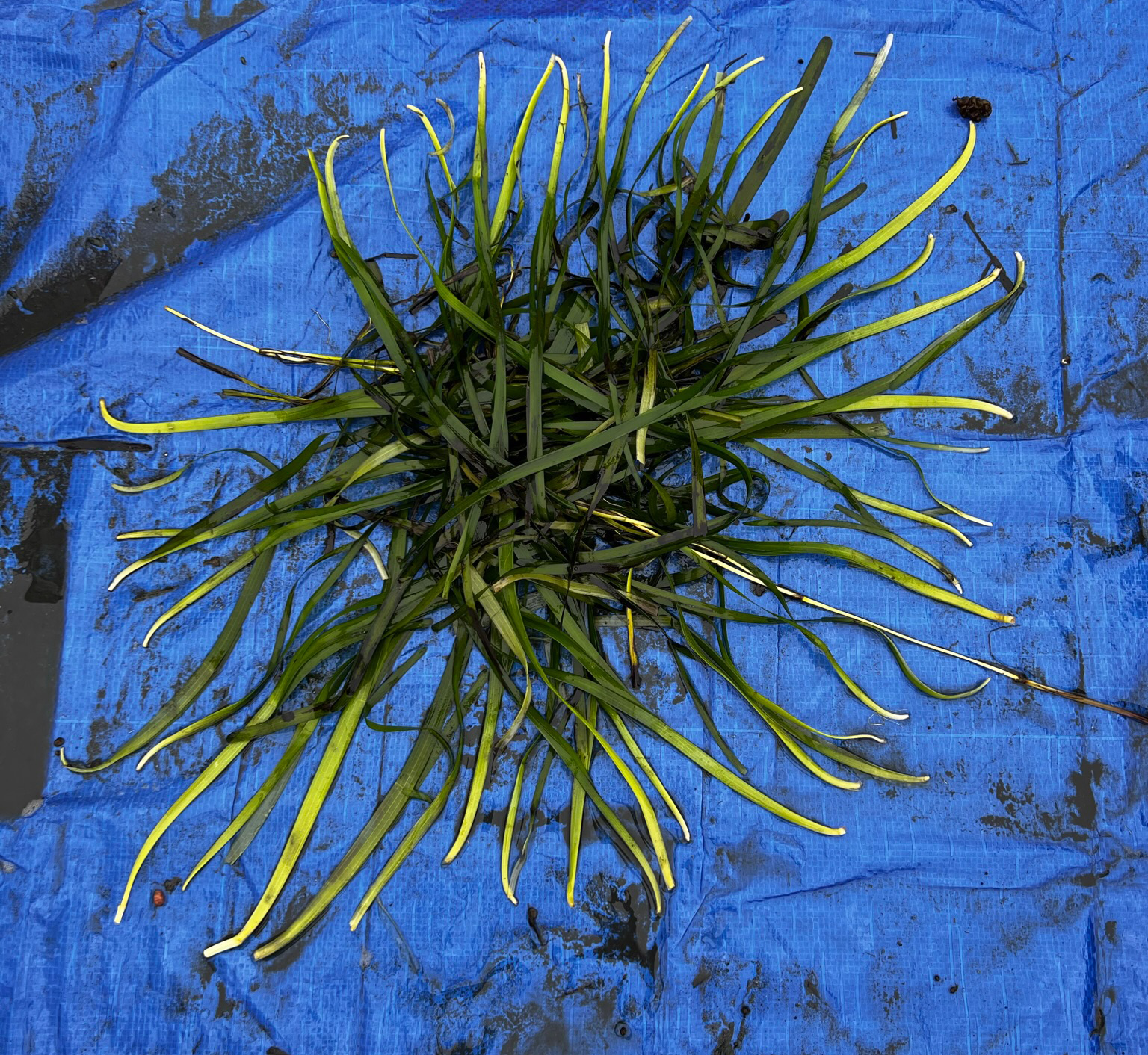
Certain seagrass-associated microbes play a key role in protecting the plant – for example, by mitigating toxic sulfide chemicals that can build up in the sediments. However, plants growing in sandy versus muddy sediments have different mixes of microbes inhabiting their roots.
In May 2025, Zabinski reported that some seagrasses have microbiomes that change upon transplantation into different sediments. Unsurprisingly, these were the plants that grew well when moved to new locations, because the plants benefited from having microbes that were adapted to local conditions. On the other hand, plants that didn’t shift their microbiomes didn’t grow as well in new locations.
This raised a potential question for people trying to restore seagrass meadows, she says. “When you bring in new plants, will they maintain or change their microbial partners appropriately, given their new environment?”
Although changing the root microbes was helpful in that case, Zabinski found that it could also have unintended consequences, making these same plants less resistant to marine heat waves and more likely to develop diseases. She found that the plants most resilient to marine heat waves maintained their root microbes, while changing those on their leaves.
This is important, she says, because a major goal of restoring seagrass meadows is “to provision them against future warming events.”
Speaking to microbes
As Zabinski completes her Ph.D. and prepares to begin a postdoc position as an Ecology and Evolutionary Biology Fellow at U.C. Santa Cruz, she is keenly aware that she – like the seagrass – has benefited from being part of a larger community.

She sees her own journey as the product of many lucky encounters with teachers and professors who became mentors. She recalls the life-changing experience of a fifth-grade field trip to Jekyll Island off the coast of Georgia, which sparked her early curiosity in marine life. She carries the ethos from her parents – both, immigrants from eastern Europe – who raised her to understand that her own life is built on the hard work of prior generations.
“I like being part of something bigger,” she says. “It’s important to be useful.”
For now, she’s focusing on the next steps in her research. She suspects that some plants have more beneficial microbial partnerships because of how they recruit their bacterial companions. It may relate to the chemical signals that they release into their environment.
“They are communicating with the microbes and with each other,” she says. She hopes that by understanding those connections, she can help these crucial plants of the ocean adapt to the challenges of the future.
Zabinski’s research is funded by the National Science Foundation, the Center for Population Biology, a Bilinski Fellowship through the Bodega Marine Laboratory, and through the MSCollaboratory funded through the Gordon and Betty Moore Foundation.
Her Research utilizes scientific facilities at the Bodega Marine Laboratory, and several other advanced facilities, including the UC Davis Host Microbiome Systems Biology Core and the Dorrestein Lab within the Skaggs School of Pharmacy and Pharmaceutical Sciences at UC San Diego.

Media Resources
- Douglas Fox is a freelance science writer based in the Bay Area.