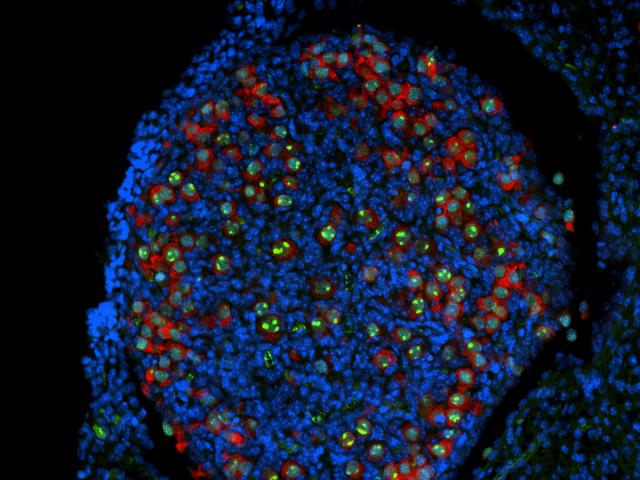
To avoid self-pollination, avocado trees alternate between opening male and female flowers at different times of day. Some avocados are female in the morning and male in the afternoon, while others are on the opposite schedule. How avocados do this has been unclear — until now.
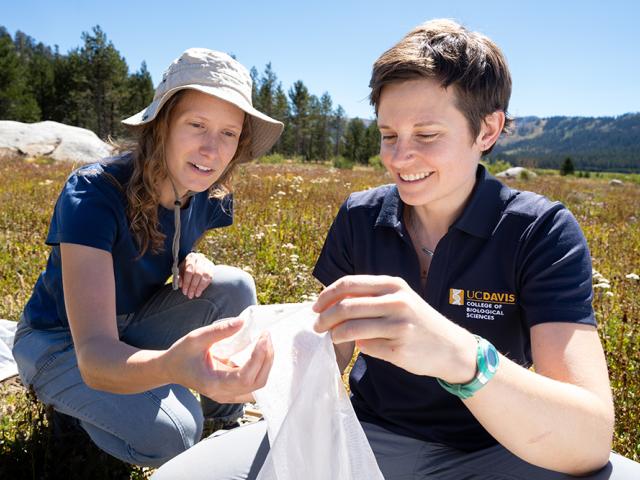
The mountain jewelflower inhabits a wide swath of California and Oregon, from summer-scorched foothills to high mountains where snow falls during winter. But it is already suffering from climate change, with plants in the mountains struggling to survive both summers and winters, according to a study from the University of California, Davis.
Xiaosa Xu, assistant professor of plant biology in the College of Biological Sciences, has received a UC Office of the President Early Career Faculty Research Excellence Award. The award includes $50,000 to support his research on the evolution of maize.
A nerve cell resembles a vast tree with branches that communicate with thousands of other cells. To function, it depends on a motor protein that walks on two legs, hauling urgent cargo from the center of the cell to the faraway tips of every branch. Scientists have unveiled a new structure of this walking protein, showing how cells control it.
Molecular biology labs rarely attract crowds, but white-coated students in UC Davis’s Esau Hall recently welcomed an unusual audience. The occasion? A celebration of the BIO123 series, the new introductory biology curriculum developed and run by the College of Biological Sciences (CBS) that serves students across UC Davis. To support the new courses, several lab spaces in Esau Hall were renovated — improvements enabled by donor funds.