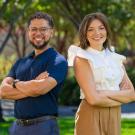
Two students from the College of Biological Sciences have been awarded the UC President's Pre-Professoriate Fellowship. The highly competitive fellowship supports professional development in exceptional Ph.D. candidates who are alumni of California-based Hispanic Serving Institutions as part of the UC-Hispanic Serving Institutions Doctoral Diversity Initiative.
The tiny aquatic hydra looks fragile at first glance, with tentacles that are slender and translucent. But if you cut it in half, each fragment regenerates into a complete new animal. Scientists studying this amazing feat have discovered a surprising detail: to trigger healing, specialized cells first have to invade the wound in a manner similar to what cancer cells do as they spread through the body.
A nerve cell resembles a vast tree with branches that communicate with thousands of other cells. To function, it depends on a motor protein that walks on two legs, hauling urgent cargo from the center of the cell to the faraway tips of every branch. Scientists have unveiled a new structure of this walking protein, showing how cells control it.
Cancer cells are quick to develop resistance to anti-tumor drugs. New research by scientists from the University of California, Davis shows how cancers adapt to evade a class of anti-tumor drugs called BET inhibitors and offers hope for more effective therapies.
The causes of male infertility can be hard to diagnose, with many tests failing to detect genetic defects. Sometimes, infertility doesn’t even involve the genes themselves. It can arise from improper folding of the father’s DNA in the sperm. If a couple conceives, this mispackaged DNA can damage the lifelong health of the child.
Thousands of times per year, a family’s moment of joy turns to unexpected grief. A seemingly healthy infant stops smiling or making eye contact. Their limbs grow weak. The tiny child suffers seizures and breathing problems.
Jawdat Al-Bassam, an associate professor of molecular and cellular biology at the University of California, Davis, often hears from these families. “I’ve gotten emails from folks all over the world,” he said.
Salicylic acid, the active molecule in aspirin and some acne medications, is a hormone in plants that is essential for immunity, but it’s a double-edged sword: too much can cause autoimmunity and stunt growth. In a new study published April 20 in Nature Communications,University of California, Davis, researchers discovered that plants use a surprising multi-layered system to regulate salicylic acid levels and keep their immune system in check.
Four faculty from the University of California, Davis, have been elected as Fellows of the American Association for the Advancement of Science, class of 2025. They are among nearly 500 scientists, engineers and other innovators that the society recognized this year for their scientifically and socially distinguished achievements.
Here are the new fellows, with their fellowship citations:
Four faculty, two each in CBS departments and graduate groups, are among this year’s recipients of the Academic Senate and Federation top awards. They are in a cohort of 15 academics across various disciplines throughout the university to be recognized.
The awards cite the impact these academics have had on their fields, on UC Davis students and on the broader community through public service.