Mental health research at the University of California, Davis, has received dedicated endowed support thanks to Bryan Cameron ’80, director of research and senior vice president at Dodge & Cox Investment Managers.
Professor Jonathan Eisen, named the first Aggie Hero of 2019-20 for calling out science meeting organizers for gender and racial imbalance among presenters, last week landed on a Time magazine list of 16 people and groups “fighting for a more equal America.”
The Center for Neuroscience at the University of California, Davis, presents its annual NeuroFest, 12:30 to 5 p.m. Saturday, March 14, inviting the public to put their mind and senses to work learning about research into better treatments and cures for mental disorders.
The award recognizes outstanding teaching and dedication to student success. Leal will be honored with other Academic Senate and Academic Federation award recipients at a ceremony in the spring.
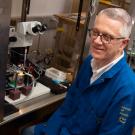
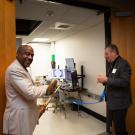
Chancellor Gary S. May and Mark Winey, dean of the College of Biological Sciences, recently cut the ribbon on a new cryo-EM facility in Briggs Hall. The $2.5 million microscope is open to all campus researchers. It can collect thousands of images a day to assemble into movies showing how proteins and other biomolecules do their work.
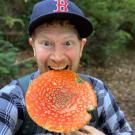
From California’s coastal forests to the north island of New Zealand, Ph.D. alum Gordon Walker has trekked for mushrooms across hemispheres. His Instagram account @FascinatedByFungi has nearly 45,000 followers. Find out more about this social media star.
Recently, graduate students in Professor Eric Sanford's Scientific Filmmaking Seminar shared their films at the Ecology Film Festival. Now you can view all 11 films in one place.
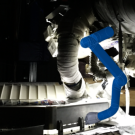
A team of UC Davis researchers look to give humanity an extra hand—literally. A new, NSF-funded collaboration between the Departments of Mechanical and Aerospace Engineering (MAE) and Neurobiology, Physiology and Behavior (NPB) plans to develop and test a robotic fifth limb to give humans extra capabilities in extreme environments.
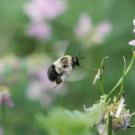
Bumblebees are the big lifters of the insect world, able to fly back to the hive with almost their own body weight in nectar on board. A study published Feb. 5 in Science Advances shows how they do it — and that bees can show more flexibility in behavior than you might expect from a bumbling insect.