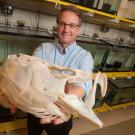
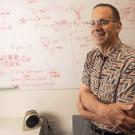
For Peter Wainwright, the academic path was simple: he simply followed his fascination with fish.
"I dare say there wasn't a lot of deep thought about what direction I should go in my life," he said. "It was more, I like fish, let's see if I can do something with fish. It was all very organic."
The American Society for Cell Biology (ASCB) has elected Dan Starr, professor in the Department of Molecular and Cellular Biology, as a 2026 ASCB Fellow.
Starr is one of 15 scientists elected this year in recognition of exceptional contributions to cell biology and the society. ASCB Fellows are selected by their peers and approved by the ASCB Council, recognizing careers distinguished by scientific excellence, leadership and service to the cell biology community.
As the planet warms, how will plants respond? For a clue, evolutionary ecologists like Sharon Strauss can move a plant outside of its comfort zone.
Strauss, a distinguished professor emerita of evolution and ecology, has conducted numerous experiments growing plants under conditions where they aren’t usually found, with the aim of studying how they’ll respond.
How can plants adapt to their environment, and how will they be able to adapt to climate change? Those are among the biggest questions Johanna Schmitt has sought to answer during her career as a plant geneticist and evolutionary ecologist.
Neil Hunter, a professor in the Department of Microbiology and Molecular Genetics and an Investigator with the Howard Hughes Medical Institute, has been elected as a Fellow of The Royal Society in London.
This prestigious appointment, announced May 20, was offered to only 70 scientists across the world.
“I’m thrilled and surprised,” said Hunter. “The acknowledgment means a great deal to me, because it’s an election by some of the best scientists in the world.”
A flowering plant might not be able to tell how many fingers you’re holding up, but it can tell whether it’s light or dark outside and might grow differently if it suddenly finds itself in the shade of another plant.
Plants do that through photoreceptors, which are a major focus of research for John Clark Lagarias, a distinguished professor emeritus of molecular and cellular biology.
Photoreceptors have important uses, like measuring the length of the day; plants can tell when seasons change because the days get longer or shorter.
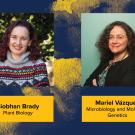
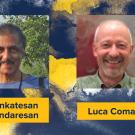
Three professors from the University of California, Davis, have been elected as members of the National Academy of Sciences. They are among 120 new members and 24 international members announced by the academy April 30.
Members are elected in recognition of their contributions to original research. Membership in the academy is considered one of the highest honors a scientist can achieve.
Ten faculty from UC Davis are among 502 newly elected fellows of the American Association for the Advancement of Science, the society announced today (April 18). AAAS fellows are scientists, engineers and innovators who have been recognized for their achievements in science, including research, teaching, administration and science communication.
Three professors from the University of California, Davis, have been elected as members of the National Academy of Sciences. They are among 120 new members and 23 international members announced by the academy May 2. Members are elected in recognition of their contributions to original research. Membership in the academy is considered one of the highest honors a scientist can achieve.